One morning last week, stuck between way too early to do much of anything and an irritating restlessness, I scrolled through unread Substack posts. One of them was part of an occasional series from Cheryl Strayed in which “she invites an author to tell us five things . . . “ I started wondering what my responses would be (which follow). And I most-definitely started wondering what yours would be (which I’m encouraging).
Thing #1: Tell us about a time when you took advice that turned out to be really good or really bad.
Almost thirty years ago now, when my daughters were only 1 and 3—my then-husband had just stepped into a pastorate that came with the unspoken (but quickly enforced) expectation that the pastor’s wife would teach a Bible study for the women of the church. I didn’t want to. At all. But at the time, I couldn’t see a way out or consider the possibility of just saying “no, thank you.” After unsuccessfully scouring the closest Christian bookstore for anything that was even remotely relevant, I found myself at a total loss. So I reached out to a woman I deeply respected and asked her what she’d recommend. Though I’m sure I’ve changed the wording over the years, this is what I remember her saying: “Why do you persist in turning to other experts, authors, and endless external sources when all you need is right in front of you? Go to the source (which for her meant the Bible), decide what you think, and then offer that.” I am 100% certain she never intended—and would probably be shocked by—the outcomes her words have garnered over the years. I did teach the Bible study, reluctantly, and with no resources but my questions and doubts, my wonderings and suppositions, my imagination and hope. And oddly, it was that very experience that led me to Seminary and my M.Div. degree, along with exposure to feminist theology and my earliest attempts at (re)writing women’s sacred stories. Now when I am asked about how I ever thought to write my book, I think back to that relatively innocent conversation. This is not what she said or even meant, but it’s the advice I’ve taken to heart ever since: “Trust what YOU think, what YOU feel, what YOU believe, what YOU know. It’s enough. You are.”
Thing #2: Tell us about a regret you have or a mistake you’ve made.
Like many women, I learned early on that my biggest responsibility was to make sure the people around me were comfortable—not at all uncomfortable with or because of me. As a child and teen, that meant excelling in school, being as close to ‘perfect’ as possible, and not disappointing anyone, ever. By the time I got married at the age of thirty, it didn’t look all that different. I kept everything in order—myself, my home, my daughters. I attempted to at least seem perfect, given that I was the pastor’s wife, after all. And I swallowed almost every one of my honest opinions, thoughts, and emotions in order to not upset the apple cart (or my husband) in any way. Though all of these things make me cringe, it’s this last one that is my biggest regret. Over time, the gap widened between what I said and did compared to what I heard and felt within. Two completely different dialogues were taking place, two completely different lives were being lived, even: inside and outside, real and pretend, broken and keeping it all together. My regret? My mistake? I wish I’d been willing to acknowledge the gap sooner, to close it no matter the cost, to be 100% myself instead of being convinced I was too much. Eventually I was able to do exactly these things. And along the way, I’ve recognized that any thought of “too much” is a lie-from-the-pit-of-hell. But oh, the years and years and years spent being so much less, holding so much back, keeping myself constrained and contorted. Yes, lessons learned. Yes, amazing growth. Yes, huge change. And undoubtedly making up for lost time in all that I “preach” these days. Still, when I look back, I grieve the young girl and the young-ish woman who didn’t know that her truest self was worth honoring, proclaiming, and trusting.
Thing #3: Tell us about a personal transformation in your life or a change that you’ve made for the better.
I could simply reverse-engineer the story above, I suppose, but something else comes to mind that I’ve been talking and writing about lately: allowing myself time and space and quiet, not always needing to stay busy, choosing to do little-to-nothing instead of always demanding more and more and more of myself. Maybe it’s that I’m now in my early 60s. Maybe it’s that both of my daughters are grown and gone, living lives of their own and on their own. Maybe it’s that I’ve moved across the country and now live in the embrace and care of my sister and her family. Maybe it’s that my book is finally done. Most probably, it’s a combination of all these things and then some. But it’s more than circumstantial; it’s intentional and within. I want to move slower. I want to feel both the expansiveness and the anxiousness of available time. I want to let go of the internal and external pressure to hustle, to create, to build, to achieve, to buy. I’m hardly successful at this. Old habits die hard, to be sure. But it does feel transformational and way better to, bit-by-bit, let go of both real and imagined demands; to not fill up every single second with something seemingly important that probably isn’t, not really; to rest and allow and “be.”
Thing #4: Tell us about your new book.
Ahhhh, my book. Rewriting Eve: Rescuing Women’s Stories from the Bible and Reclaiming Them as Our Own. It will be published one month from today (!!!!) which seems miraculous, given the nearly 20 years I’ve been working on it! In so many ways, it is the fulfillment of the three responses above: an expression of trusting my own thoughts and very self; closing the gap between 100% authenticity and cultural, religious, family, and even self-expectations (and longing for the same in everyone who reads it); letting go of every story that doesn’t serve and choosing instead, a story that is fully our own. I’ve rewritten ten ancient, sacred stories of women. Trapped in patriarchy and theological argument, dismissed as irrelevant, or viewed as unchangeable even as times change, these women’s voices, desires, and hearts have too often been silenced through misunderstanding and neglect. As result, we are as well. But when they are reimagined, deconstructed, disentangled from doctrine and dogma, and heard on their own terms, these stories become powerful inspiration and a source of discernment that reconnects us to a feminine lineage and a sovereign sense of self we’ve never known to call on or trust. Rewriting Evereveals the powerful ways in which these women and their stories still speak; all they long to say; all that you deserve to hear and know and trust on behalf of your story.
Thing #5: Tell us your best advice.
Slightly repetitive, but no less passion-filled or heartfelt: be 100% yourself, 100% of the time. Can this be risky or costly? Definitely. Are there consequences? To be sure. But being less than who you fully are is even riskier and more costly; those consequences too numerous to count. You deserve to be all of who you are, no holding back, no playing it safe, no attempting to keep others safe (which is really their issue, not yours), no compromise or compliance, all you . . . always! (I’m right about this!)
*****
This 5-things process—which I think is better called a practice—has been well worth my effort and energy. To pull back and reflect on exactly how, why, and in what ways I’ve changed and grown over the years, to consider the wisdom that has mattered the most along the way (for good and/or for ill), and to think about any/all of this as though Cheryl Strayed were asking, has been significant. It’s not that my responses have surprised me; rather, taking the time to consider them, write them out, edit them down, and be 100% certain they are 100% true, has felt amazingly grounding and definitive and strong. I think, at least in part, it goes back to what I said above: we are so convinced that we have to do more to arrive or be good enough or feel like we are enough. But when we stop and reflect, when we pay attention to our own stories and that know-that-we-know-that-we-know voice within, just the opposite becomes clear: we already are enough and always have been. Sometimes that awareness gets buried under other stories, disappointments, grief, others’ expectations of us, and just life itself . . . which is why it’s worth looking closer, digging deeper, and believing that Cheryl Strayed can hardly wait to add you to her occasional series!
So, your turn! Tell yourself five things (with a few more besides):
Tell about a time when you took advice that turned out to be really good or really bad.
How did that advice shape you?
In what ways have you either developed it or deviated from it? Why?
What advice do you wish you’d been given?
Tell about a regret you have or a mistake you’ve made.
In what ways has this very regret or mistake shaped the way in which your life has gone, the choices you’ve made instead, the changes it either forced or invited?
With that perspective, is it a regret or a mistake?
Tell about a personal transformation in your life or a change that you’ve made for the better.
What are the changes you yet want to make? What holds you back? Why? What if you stepped into and toward them anyway?
Tell about your new book.
Some options here: tell about the book you intend to write, secretly long to write, or wish someone else would pen on your behalf.
Tell your best advice.
How is this different from what you might have said 10, 20, 30, or more years ago?
What advice do you hope you are offering in another 10, 20, 30, or more years?
One last thing: Your every response is worthy of being articulated, whether Cheryl Strayed hears it, or not. Here’s why: every experience you’ve been through, every bit of the perspective you’ve gained along the way (especially the hard way), every transformation or change you’ve made, every word you’ve spoken and/or written, is what creates and shapes the advice and powerful wisdom that is yours alone to give; ours to witness and benefit from. (I’m right about this!)
As named above, my book will be published one month from today! I can hardly believe it and am beyond-thrilled! There’s still time to preorder (which matters so much for first-time authors). Thank you!!
We’ve grown up on stories: fairytales, bedtime stories, religious stories, history, myth, legend, lore. Not to mention the stories of our family—some reinforced, others rejected, but no less pervasive. And then there are the those of our world, our culture, our socio-political reality, the news, social media, and more.
Every single one of these stories has shaped the way we understand the world and our place in it—our day-to-day life, our work, our relationships, our sense of self, everything. Stories make us who we are. They make you, you.
The stories we’ve not been told (or don’t tell).
These often speak louder than all the others. Stories of harm, loss, pain, grief, disappointment, and anger remain, whether acknowledged or not. Their wounds are still felt and we are held captive to them. They shape us, endlessly and ongoing.
And lest we forget, there are so many stories we’ve not been told nearly enough if at all. Stories that speak of a woman’s strength, tenacity, wisdom, courage, and hope. When they remain untold, it is hard to live a story defined by anything close to the same.
The stories we tell ourselves.
Stories told and stories denied become the incessant and endless voices that chatter within. Cinderella’s story becomes the voice that says you’re not enough unless beautiful, unless something magical occurs, unless you are rescued. Pandora’s story becomes the voice that says you’re too much. The unacknowledged or unhealed story of your past (and those of generations before) becomes the voice that says you should just keep quiet, keep the peace, keep complying and compromising and morphing and towing the line. And as long as there are untold, silenced, and shamed stories of women in our collective, matrilineal line, we hear the voice that tells us there’s no precedent for change, for transformation, for hope. To be clear, all of these voices are wrong!
The world is perfectly content to have us consumed by stories like these. It is determined to keep us from stories of a woman’s agency, courage, wisdom and worthiness. It works to convince us we do not have either the power or the permission to live our story on our own terms. And though there are a million reasons why this is so, I circle right back to one particular story.
The story of Eve.
. . . whether you’ve heard Eve’s story a thousand times or just this once—it has shaped your life as much as it has mine. It has “served” as the predominant religious ideology, normative cultural template, and overarching social framework for nearly every aspect of the Western world. It is not a stretch to claim its impact and presence within the realities women face, like unequal pay, fewer leadership positions, domestic violence, sexual harassment and trafficking, unraveling abortion rights, and more. All of these are informed and influenced by an inherent understanding of women that, though often unspoken, is no less living and active for the silence around it.
Yet none of this is because of Eve herself, or even her story!
“History isn’t what happened,” says noted women’s historian Sally Roesh Wagner. “It’s who tells the story.”
. . . I sometimes worry that I am overzealous in my unswerving belief that the telling of Eve’s story has and does determine the treatment of women past and present—that perhaps I am taking things too far. But then I . . . am reminded that nearly every example of women’s silencing, shame, and status (or lack thereof) is rooted here, in one singular story. It is tempting to walk away, even from Eve herself—to throw out the whole damn thing. But what I have come to see and experience is that every bit of the endless pain and misunderstanding that has resulted from her story’s telling invites me to healing and deeper understanding, an undoing of the past and a rewriting of the future. When I accept this, the blatant disregard and disdain for Eve (and too many women throughout time) becomes my most profound source of hope, a determined pursuit of all women’s honoring. And the acknowledgment that Eve’s story, as it is most often told, has caused centuries of upset and disruption allows me to dream of what is possible when it is reimagined and retold for good. She has proven her capacity to change everything! Which means she can yet again, which means that you can as well.
In the old stories, it is women who make the world; why then shouldn’t we remake it? ~ Sharon Blackie
Eve’s story, one of the oldest stories, is the perfect example of what can happen when a story is reimagined, retold, and redeemed; when what has been seen as shameful is made sovereign; when a world and a woman are remade. She and so many other women beside, our entire matrilineal line, invite us to exactly this again and again—to become the tellers of our own story, our own protagonists, our own heroines, the ones holding the pen and trusting our wisdom and eating the fruit, the ones who change everything.
None of this is easy. It’s ongoing and endless. In truth, it makes up and takes an entire life. But to bravely rewrite the stories that have shaped us, to passionately create the ones we’re yet to live, and yes, to most-definitely change everything along the way, is the story that is ours to tell . . . and live: bold, amazing, unapologetic, and glorious.
May it be so.
I hope you’ll preorder my book—now only 37 days away from publication! It’s available wherever books are sold (though I’m partial to Bookshop.org). Oh, and this week’s BIG NEWS? Studio time has now been scheduled by the publisher of the audio version! Woohoo! Rest assured, I’ll let you know the second you can download my voice reading my words on your behalf!
I can barely believe that my book’s publication date is only 44 days away! It is daunting, exciting, humbling, and a million more emotions, besides. Highest on the list though, front and center, first and foremost, is the thrill of knowing that what I’ve been holding close for nearly twenty years is about to move from my hands and heart to yours. Gift and grace, to be sure!
Today’s post is but a taste of the ten stories within the book and the many vignettes held within each of those. I’ve chosen just one and, not surprisingly, about Eve.
Enjoy!
“One of the most powerful ways in which we initiate change and transformation—in our own lives and in the world—is to unequivocally name all that has kept us small, silenced, shamed, or trapped, and then do exactly the opposite. It’s a necessary discipline to contradict all that has been so deeply ingrained within us, to defy any and everything that holds us down and back, to literally upset the apple cart.
“We do this at a systemic level by applying intelligent critique to any policies, protocols, theologies, or politics that hinder women’s growth, self-expression, and inherent worth. We lobby. We protest. We vote. And we persist. Sojourner Truth articulated this perfectly when speaking at the Equal Rights Convention in New York in 1897:
If the first woman God ever made was strong enough to turn the world upside down all alone, these women together ought to be able to turn it back and get it right side up again! And now [that] they are asking to do it, the men better let them. Truth burns up error.
“The day after Donald Trump’s inauguration in 2017, I attended the Women’s March. It was the largest single-day protest in US history; worldwide participation was estimated at over seven million. What a powerful experience to be surrounded by throngs of women, men, and children—all of whom had come together on behalf of women’s rights, human rights, really. As I was jostled and carried by the crowd, I remembered Eve. I wondered how she felt about the whole thing—the pink hats, the sea of signs, the electrifying speeches, the solidarity that swelled as so many of us demanded that things be “turned right side up again.” I am certain she remembered the Garden, her unswerving clarity as she honored her agency and desire, and the taste of the fruit. . . . And I am certain she smiled during those hours as so many of us gathered, grateful that we were tasting the same.
“For as much as I loved being part of that day, I know the change we desire and deserve is far easier painted onto a sign than brought into being. And as much as I would like to (and do) blame Donald Trump and so many others like him for every limit, constraint, and lack ofhuman rights that women have known throughout time, I also know that much of what holds us back comes from within.
“My inner critic is alive and well. It has the uncanny ability to completely derail me, my confidence, my choices, and certainly my actions. It doesn’t matter that I know it to be nothing more (and certainly nothing less) than an accumulation of patriarchal messages, doctrine and dogma that no longer serve, culturally reinforced misogyny, old stories, capitalism’s endless effort to convince me that I am not enough, and my own laundry list of perceived failures, mistakes, and faults. Still, it natters on and shuts me down.
“Until I remember Eve.
“When I do, I can extend myself grace and acknowledge that this caustic voice within has, in large part, been shifted and shaped by poor tellings of her story—threads and themes that echo, You’re to blame. Don’t trust yourself. You’ll only wreak havoc if you follow your instinct. Stay inside the lines. When I hear their hiss, something in me rises up, defiant and determined, hand-painted signs at the ready. It’s as though she speaks through me, as though she’s been waiting for the opportunity to set right all that has been turned upside down within me and my world. And sometimes I catch a whiff of something fresh and crisp in the air—an apple, maybe. . . .
“Reimagining and remembering Eve’s story is both a collective and personal act. It is a radical act. And it summons the change we so deeply desire—for all women, all humans, and most certainly ourselves. Indeed, ‘to get [the world] right side up again!’”
How about one more?!? (This is why I need those 44 days to hurry up: I am so excited for you to turn these pages for yourself!)
“Sometimes, oftentimes, we struggle to believe in our divinely decreed value and worth, not so much because of Eve but because of her god. Well, not her god, exactly, but the one of whom we’ve been told.
“East of Eden—after Eve’s choice—God’s direct interactions, intimacy, and care increase exponentially. Beginning in Genesis 4, an epic story commences: scene after scene of God in conversation, in actual appearances, offering protection, presence, and love for generations. Eve’s story, when retold, enabled the overarching story of scripture to be told in all three Abrahamic traditions—Judaism, Christianity, and Islam: a chosen people, cared for by the divine, delivered by their god into a promised land. And all of this after and because of Eve.
“Eve’s god does not demand our obedience or perfection but instead fully embraces our deepest intuition and bravest choices. Eve’s god shows up, walks alongside us, and reminds us that our wisdom can be trusted—that we are trusted. Eve’s god is not obsessed with sin but with reconciliation and relationship. Rather than require that we prove ourselves or be better or hold ourselves back or reign ourselves in, Eve’s god reminds us, again and again, as does Eve, that we reflect the divine and our desire is good.
“We should be thanking her instead of blaming her.
“It’s not too late.”
As named above, Eve’s is only one of ten stories I reimagine and rewrite within Rewriting Eve: Rescuing Women’s Stories from the Bible and Reclaiming Them as Our Own. Each woman is so powerful, so brilliant, so real, and so worthy of being known, heard, seen, and honored—as are you. I can hardly wait for you to meet them for the first time, or perhaps in a much different (and much better) way. It’s about time: you are, after all, their daughter, their lineage, their kin.
*****
You can preorder Rewriting Eve now. These early days of ordering are so important for first-time authors—giving vendors a sense of demand and desire. Head to Bookshop.org (in support of independent booksellers), Amazon, Barnes and Noble, Target, and wherever books are sold! Thank you!
And did I mention that publication is just 44 days away?!? Eeeeeeeee!
It’s been nearly three years since I left my verybusy and verystressful corporate position, just over one-and-a-half years since I moved from the West coast to the East to live with my sister and her family, and eight months since I turned in my book manuscript to the publisher. Each of these transitions (and many more besides) have offered me increasingly more time and more quiet, along with more resistance to the same.
I took this picture one week ago today—enjoying both time and quiet. (The beach definitely helps!)
You’d think it would be just the opposite: that as demands and deadlines and expectations have lessened, I’d be completely on board; thrilled, even. And in so many ways, I am. Still, the spaciousness can feel unfamiliar and slightly angsty. So, I fill it. I scroll through Facebook, Instagram, and Substack. I rearrange things—books, furniture, décor. I find something to eat. I struggle to sit still. My heart rate is higher than I’d prefer. My brain races through a million-and-one ideas and inner voices chatter away. And though I’m not crazy about any of this, it all feels familiar, normal even.
I am, of course, conditioned to believe this isnormal. Hustle-and-grind culture. Capitalism. Patriarchy. Keep busy. Do more. Buy more. Strive. And be proud of every bit of this! As much as I would like to believe that I am immune to such things, their influence pervades. Add in a not-so-healthy dose of the Protestant work ethic and it’s hardly surprising that I struggle with the spaciousness of time and quiet. I always have.
Apparently the Universe knows all about this highly-honed tendency of mine and so, placed the following quote in my path a few days back:1
In the stillness of the quiet, if we listen, we can hear the whisper of the heart giving strength to weakness, courage to fear, hope to despair. ~ Howard Thurman
When I read it the first time, I felt like I was back in Driver’s Ed—the instructor suddenly slamming on the brake, lurching to a stop that I didn’t intend or initiate. Shocked into attention. Getting my bearings. Right: stillness, quiet, listen . . . When I read it again, my breathing started to slow and I reveled in the phrase, “the whisper of the heart.” In subsequent returns to these words in past days, I’ve been able to hear my own questions make their way to the surface: Is my resistance to both time and quiet actually resistance to something else? Where do I know (but struggle to admit) places of weakness or fear or despair? What am I attempting to sidestep by staying busy? What will I hear if I actually slow down and listen to the whisper of my heart? Why am I avoiding that?
*heavy sigh*
*****
I’ve read a ton of novels in which the protagonists spent their childhoods lost in books, wandering in fields, staring up at the clouds, living in their imagination. I am admittedly envious. Maybe I had my own version of the same, but the edges are blurry . . . and busy. I seem to remember that there was always something to do, something required, no time to waste, “idleness is the devil’s workshop,” all that. I’ve seen the evidence of pictures I drew, images I made out of scraps of fabric glued on paper, slides (yes, “slides”) of me dressed up and performing plays. And of course, I spent plenty of time on the floor of my bedroom with Barbies. (I could be wrong, but I’m relatively certain I spent more time constructing their world—organizing it, really—than dreaming up how they moved through it.) My tangible recall is connected to practicing the piano, doing homework, memorizing poems and Bible verses, completing required chores, caring for my little sister, and subconsciously making sure circumstances, situations, and people remained calm and copasetic. And though it nearly breaks my heart, I’m not sure I did much better with my own daughters— allowing, even encouraging time and quiet, inviting them into the joy of expansive space with nothing required, nothing expected, nothing to do but “be.”
There was a particular season in which I diligently and very consciously stayed busy so that I could avoid all that was dysfunctional, painful, and sad in my then-marriage. My house had never been so clean: dishes washed, countertops glistening, rugs vacuumed, knickknacks dusted, bathrooms sparkling, every toy in its place at the end of the day. My time was rigidly scheduled and planned—a self-inflicted discipline and demand. And I went to bed each night as quickly as possible, feigning sleep, once the girls were tucked in, stories read, kisses given. I desperately needed everything in lock step, contained, clamped down, controlled-controlled-controlled. Otherwise, the smallest windows of time or quiet might open up. They would usher in too many thoughts, too many emotions, or worse, an actual conversation that I knew wasn’t going to go anywhere good. Had I given myself permission to stop, to rest, to listen, to “be,” my heart would not have whispered, it would have screamed.
*****
My life, both within and without, is very different now thanks to therapy, spiritual direction, a divorce, the constancy of dear friends, the respite of writing, and many, manyyears passed. My proclivity for staying busy has hardly disappeared; it remains my default, to be sure. But now, more often than not, I can see it, spot it, and occasionally even stop long enough to look a little closer and dig a little deeper.
Not always, but sometimes, even as I mindlessly scroll or rearrange or make myself a snack, I can reflect: What would happen if you put down your phone? What might you do (or not do) if you just let that pillow stay exactly where it is? What are you actually hungry for that has nothing to do with food?Not always, but sometimes, I can slow down, sit still, inhale and exhale, and listen to the answers my own questions summon. Not always, but sometimes, I can allow the emotions that accompany and swirl. Not always, but sometimes, I can extend myself grace for the places in which I feel weak and unsure, afraid and ambivalent, despairing and discouraged. And not sometimes, but always, I am grateful when I can let all of this just be, when I can just be, instead of literally and figuratively attempting to sweep it under the rug.
There has been no space for any of us to dream of anything outside of what we have been born into. To hear the simple and bold proclamation, “You are doing too much. You can rest. You can just be. You can be,” is revolutionary.
I’m all for that revolution.
Perhaps one day I will revel in a spaciousness so vast that I wander and imagine and dream without a thought of picking up my phone or straightening a piece of art on the wall, or seeing if there are still Doritos left in the pantry. Perhaps one day I will allow a silence so long and deep that even the voices in my head are hushed in awe, and it never occurs to me to feel restless or anxious or god forbid, unproductive. Perhaps one day I will recognize the quiet as a dear friend who sits by my side as we watch the sun dip below the horizon, not a single thought of doing more, buying more, being more . . . instead, clear that thisis more than enough, that I am. Perhaps one day “the whisper of the heart” will overtake and heal every pattern of staying busy, any belief that equates my value with effort, any voice that hints at anything other than “just be.”
For now, I suffer no illusions about the time-worn and culture-reinforced grooves that lure me to distraction, that attempt to protect me from feeling what I feel. But here’s the thing: every one of my oh-so-diligent efforts to fill up spacious time and tamp down ample quiet actually serve me. They are generous reminders and wide-open invitations to pay attention, settle down, return home to my very self, and listen to my ever-whispering heart.
In the stillness of the quiet, if we listen, we can hear the whisper of the heart giving strength to weakness, courage to fear, hope to despair.
May it be so.
A P.S. of sorts: In conversation with one of my spiritual-direction clients a few days back, I invited them to consider a place in which they are struggling as an opportunity to form a sacred-practice.
When connected to the church and religion for any amount of time, especially if we grew up in such, we adopt particular practices: prayer, confession, communion, etc. But when we disconnect and leave these behind, or are in the process of such, we often feel a gap, a loss, even a hunger for meaningful rituals and routines that were once part of our everyday life.
So, as it relates to time and quiet—particularly, if like me, you fill them up with busy-ness and distraction so as to ignore the thoughts and feelings that surface—consider letting the awareness of your own patterns and behaviors (scrolling on your phone, rearranging furniture, searching for Doritos) be a grace-filled invitation to the sacred within, an intentional returning to self, a deep breath and a “thank you.”
These very things that perplex and/or frustrate you (often about your self and yes, even others) are like a bell that rings, ushering you into a sacred practice that strengthens and sustains. These very things ARE “the whisper of your heart,” no matter how faint, calling you home, again and again.
Ugh. To gain even the slightest insight into how I feel about this topic, you only need to hear the deep breath I just took and see how my shoulders slumped as I typed that singular word.
I do not like it. Not even a little bit. I never have. This is not to say I haven’t tried to like it, at the very least to persist. I’ve joined gyms, fitness centers, and workout programs designed exclusively for women. I’d downloaded apps. I’ve subscribed to online plans that have made amazing promises (along with a lot of fine print). I’ve bought a treadmill—then sold it. A Peloton—then sold it. I’ve had at least two yoga mats over the years that have been donated to Goodwill, almost completely unused. Weights, same. Even my desk converts to standing (a purchase I was sure I’d take advantage of), but I never press that button. I can find a gazillion reasons to not exercise. Well, up until last week.
My sister and brother-in-law spotted a gym just down the road from our house. Tom scoped it out on Monday and then took me with him on Tuesday before signing up, so that I could decide if I wanted to get in on the family discount. It’s a nice-enough place. Cardio equipment. Weight machines of every size, shape, and configuration. A pool that hosts water aerobic classes. Yoga (including “chair yoga”). Zumba. Spin. Tabata. Courses that are just for seniors—which, I guess, actually includes me. Personal trainers. Nutrition counseling. A smoothie bar. And an app for scheduling all these and more from the convenience of my phone.
I didn’t want to say “yes,” but I did. I want to want to go. And I do actually want to like it—exercise itself. Still, I’m not hopeful.
Do you remember the President’s Fitness Test? It’s highly possible that my resistance (and disdain) started there. The original six-part test consisted of push-ups, pull-ups, sit-ups, a standing broad jump, a shuttle run, a 50-yard dash and a softball throw for distance (ostensibly, according to this article, because it’s helpful to know who amongst the troops has the arm strength necessary to chuck a grenade the furthest, or at all). I hated the days set aside every year for these ranked activities. I could not do the pull-ups at all, the push-ups and sit-ups barely. A standing broad jump? Are you kidding? And the running—for speed? Uh, no. Let’s not even talk about the softball throw. All of this felt like a tortuous experiment to discern just how much shame an adolescent girl like me could endure. The answer? A lot.
Beyond this annual torture, there was recess and PE. I would have far preferred to sit in the corner and read a book than have to engage in activities that consistently left me feeling less-than, uncoordinated, unchosen and unwanted. Dodgeball. Tetherball. Four square. That dreaded horizontal ladder I watched my friends swing across with ease and joy. (More deep breaths and shoulder slumps just remembering all of this.)
I’d like to tell you I’m past all of this now, that these (very) old stories are no longer present in my psyche . . . nor remotely relevant. Still, as I walked through that gym just a few days ago, it all came flooding back. I saw the in-process “High Fitness” class filled with close to 30 women moving to loud music and the instructor’s endless “whoop” keeping time to a thumping bass; the incredibly strong (and buff) people lifting free weights and using machines I’m quite sure I should stay far, far away from; the pervading presence of muscles and discipline and skill, even ease. It was like I was 12 years old: I felt insecure, out-of-place, and instantly ashamed.
It somehow doesn’t matter that I know better, that I can most-certainly get on a treadmill or stationary bike without hurting or embarrassing myself, that I can probably even take a water aerobics class and survive. It doesn’t even matter that I know any and all of these things will make me feel better, increase my range of motion, build needed (and admittedly declining) strength. Somehow, the indelible reminder of shame supersedes my sanity—even now, even still.
I’m pretty sure I’m not the only one. And I’m definitely sure this is not limited to physical fitness or lack thereof. All of us have stories, memories, and specific places/events that, when replicated in the slightest, compel us to resistance and avoidance. It’s understandable. It’s allowed. And it’s normal. Of course we stay away from scenarios and experiences that summon unpleasant emotions! But here’s what I’ve been asking myself this week: What if I was able to let go of the story I’ve been telling myself for more than fifty years and instead, choose a new one?
What if, indeed!
You wouldn’t think this was much of a revelation for me, given that I talk and write about this all the time: the honest naming of the stories that have shaped us, our sovereignty to write them as we wish—with wisdom, courage, agency, and hope. But often hidden in unsuspecting places, is continued opportunity for me to practice what I preach. Thankfully.
So, Tuesday morning I said “yes” to the gym membership. Wednesday morning I went to a water aerobics class. Then again on Thursday. And Friday. (Shocking, I know!)
Believe me, I am under no illusion that three 45-minute sessions in the pool have miraculously cured me of my exercise-dislike. (It’s a wonder I returned after the first one given that the entire class, all 45 minutes, was choreographed to only remixed Madonna songs!) But then exercise isn’t really what I’m writing about here.
What I am writing about is taking stock of the poured-in-concrete stories we fervently cling to and faithfully believe (especially when we’re barely aware of such), the stories that still shape our choices or lack thereof, the stories that have formed our preferences and likes and dislikes, the stories that have kept us convinced of what we can and cannot, will and will not do.
Our perspectives on self and body and appearance.
What we believe about money and success.
How we view race and class.
What constitutes goodness and good enough.
Why we stay in relationships that do not serve.
Why we too-often compromise and comply.
Where we land on religion, politics, gun control, abortion, and issues of gender and sexuality.
Which battles we’ll fight and which we’ll intentionally avoid.
How we parent.
What we think of conflict.
What we tell ourselves, over and over and over again, about where and why we fall short or aren’t enough or are most-definitely too much.
None of our beliefs, attitudes, opinions, or behaviors related to any of these are formed in a vacuum, ex nihilo. They are formed and then reinforced by the stories we’ve been told, the ones we’ve lived, and those we continue to tell ourselves. When we look closer and dive deeper, when we honestly and bravely name our experiences and memories—especially the ones bound in shame—we are able, bit-by-bit, to choose and step into a new story; a story that is shaped by our own intention, choice, and will.
It’s possible that all of this sounds far too simplistic, as though *just* acknowledging an old story or two about exercise has somehow magically converted me into a water aerobics fan or fitness fanatic. Uh, not so much. But here’s the thing: in my experience, it’s been seemingly small “a-ha’s” like this one, tiny and unexpected glimpses into my subconscious, that wake me up to the possibility of change, to a different story, to one that is completely and wholly mine.
I’ve highlighted this quote before, but it is worth revisiting:
“Those who do not have power over the story that dominates their lives, power to retell it, to rethink it, deconstruct it, joke about it, and change it as times change, truly are powerless.” ~ Salman Rushdie
I hope you’ll join me in endlessly and infinitely looking closely and with tender care at the stories that have dominated your life; that do so even now, even still. I hope you’ll do as Rushdie recommends: retell them, rethink them, deconstruct them, and if appropriate, even joke about them; give yourself permission to change them as times change. You deserve to live the story that you choose, that you write, that you desire. Yes, even if it includes exercise.
One of my daughters used to get so excited for her birthday and Christmas—counting down the days, rehearsing all the details-specifics-traditions to ensure perfection, and pretty much oozing anticipation and joy. But as memory serves, there were a few early-teen years in which she’d politely say “thank you” for each gift and then as quickly as humanly possible, escape to her room, shut-if-not-slam the door, and sob in bitter disappointment.
I did not always often handle this well. I was frustrated she wasn’t more grateful, happier, elated, even exultant. And I was hurt: so much time and attention paid to making sure everything was special only to have her feel like none of it was enough. I know: I made it about me. Blech. It’s one of the many things I’d go back and redo if I could. I’d acknowledge just how hard it can be to live with the gap between expectations and reality. I’d name just how painful it is to realize something is finished that you’ve looked forward to for so long. I’d give her permission to feel what she feels without the slightest hint of my judgment. *sigh*
It is easy to say that this was simply a child’s perspective. She hadn’t yet discovered that life is unfair. She’d not been battered down by disappointment’s frequent and repetitive presence. OK. Maybe. But here’s the thing:
It is brave to live with an unswerving commitment to celebration, to revel in anticipation, to plan on joy, and to hold firmly to hope.
*****
Now, so many years removed, I wonder whether or not I have the courage to “practice what she preached” in such a tender and poignant expression of her heart. I wonder whether or not I will give myself permission to revel in anticipation and plan on joy and hold firmly to hope. I wonder whether or not I will let myself feel what I feel. I wonder if I will celebrate at all or if, instead, I will protect myself from the massive risk inherent in every bit of this. And I’m wondering all of this on this day, today specifically, because it is worthy of celebration:
It is exactly 100 days until my book is published.
*****
I know! Woohoo! Cue the confetti, the champagne, and the celebration! That does seem the appropriate response. But truth-be-told, I’m not feeling nearly that brave.
I’ve been watching the countdown app on my phone inch closer to double-digits for a very long time now; the exact date, 10.3.23, has been staring at me since mid-December, 2021. When I signed the contract with my publisher, nearly two years of forced patience seemed an eternity. As the days, weeks, and months have passed—and especially as the deadlines have loomed—it’s seemed way too close. And in-between time moving like molasses and now being right-around-the-corner, I’ve known every emotion under the sun: excited, panicked, honored, nervous, thrilled, hopeful, anxious, and yes, even exultant.
Today? Exactly 100 days out?
I feel resistant to feeling much of anything.
I know it’s ridiculous. I should be overwhelmingly thrilled at being so close to the finish line of this long-pursued accomplishment: my near-singular intention and aspiration for almost two decades. I’ve given countless hours of my life to these 237 pages that feel more like 2370 and then some. I’ve labored and wept, typed and deleted, hit “submit” and wished I hadn’t, doubted and trusted it would ever happen. I’ve accepted (and sometimes rejected) the recommendations of editors and proofreaders. I’ve wrestled with my perfectionism again and again. And I’ve realized how shockingly hard it is to let go, to place my writing, my work, my book, my very heart, in someone else’s hands—in your hands. It gets worse . . .
Even a small sampling of my inner dialogue (that I’m not at all proud of, but which is no less loud or real) sounds something like this: What if October 3 gets here and I’m bitterly disappointed? What if everyone else is? What if, after all this time, the day just comes and goes, completely anticlimactic? What if the book is not all that good? What if it’s nothing special or meaningful or impactful? What if I’ve built this up to be so much more than it actually is or could ever be? What if it doesn’t sell, doesn’t speak, doesn’t matter? (I know you so want to disagree with me right now, to tell me just the opposite, to encourage me, to remind me of what’s “true.” Believe me, I get it! And thank you.)
Every bit of my exaggerated caution, my reservedness, my insecurities, and even my stated lack of feeling (which obviously isn’t accurate), is the antithesis of my daughter’s then-reality. She dove right into the thick of each celebration, head first, with complete faith that it would be glorious. It never crossed her mind to temper her expectations, to hold back her enthusiasm, to picture the day being “less than” she’d imagined.
All of us were just like her at one time, I suppose: not yet jaded by “Santa” putting fruit in our stockings (fruit?!?), unwrapping gifts that weren’t quite what we asked for (or anywhere close), knowing more times than not when desire and reality didn’t quite match up—relationships that failed, jobs that didn’t remotely resemble what we’d been promised, the myriad of other lessons-learned that life has oh-so-consistently brought our way. These singular experiences, along with their many forms, have the tendency to convert themselves into our most deeply-held beliefs:
If I don’t expect more in relationships—when I opt for compromise and compliance over truth-telling—I don’t have to feel the disappointment of not really being loved for who I am.
If I don’t put myself out there at work, I don’t have to risk the disappointment of not getting the promotion, the raise, even much-deserved praise for the above-and-beyond effort I’ve consistently extended.
If I don’t have the difficult conversation with my kid(s) or significant other or parent(s) or friend or co-worker or boss (or all of the above), I don’t have to deal with the disappointment of things getting even worse.
If I temper my words and emotions to fit what I’m convinced others can (or cannot) handle and/or want from me, I don’t have to experience the disappointment of being unseen, unheard, and rejected.
[H/T to my daughter: if you don’t anticipate that your birthday or Christmas will be full of celebration, anticipation, joy, and hope, you don’t ever have to feel the disappointment of “less.” I’m so sorry about this, sweet girl.]
And let’s be honest: if I don’t acknowledge and honor something as simple and relatively small as today, it’s all part of my bigger plan to not be disappointed if little-to-nothing monumental happens 100 days from now.
Ugh. Every one of these statements is gray and pallid. My shoulders slump as I type; I hear my own heavy sighs. Yes, on some level it makes sense: my reluctance to risk celebration and all that goes along with it, to hold back, to prize my oh-so-amazing ability to successfully manage my emotions. (I’m being sarcastic. It’s not an amazing ability at all.) But a wiser and way-braver part of me screams, Nooooooo!
Anticipating disappointment instead of allowing joy is not how I want to live.
*****
Defaulting to self-protection over vulnerability, repression over expression, safety over risk, or a lackluster meh over jubilant and unrestrained celebration is not at all representative of how and who I want to be.
I’m loathe to be seen as a silver-lining kind of person. I’m definitely more glass-half-full than empty, but I have little patience for worn out cliches, irritating axioms, or warm-and-fuzzy memes. All this said, it still seems important to name (and yes, even celebrate) that the risk and even experience of disappointment is actually what enables joy to be so much more deeply felt. The very possibility of loss is what invites our appreciation, devotion, presence, and love. Our previous heartbreaks are what make a new (and healthier) relationship feel not only amazing, but miraculous; what makes our sense of self feel whole, intact, and strong. Our former mind-numbing work is what validates our now-felt energy and excitement for how we spend our days. And our fear of pain, when acknowledged and maybe even overcome (at least in moments), is what makes our bliss, well . . . bliss!1
Here’s what’s true: Our lives are not a binary; they do not go one way or the other— black or white, up or down, good or bad. We don’t celebrate or avoid the mere mention of it. We don’t experience disappointment or joy, loss or love, heartbreak or healing, soul-sucking work or satisfaction, pain or bliss. We know and feel all of it, all the time.
You don’t have to take my word for it.
“. . . to believe in something with your whole heart, to celebrate a fleeting moment in time, to fully engage in a life that doesn’t come with guarantees – these are risks that involve vulnerability and often pain. But, I’m learning that recognizing and leaning into the discomfort of vulnerability teaches us how to live with joy, gratitude and grace.”
~ Brené Brown
Full engagement and no guarantees. Risks, vulnerability and pain. Discomfort and joy, gratitude, and grace.
Deep breath.
I wonder how all of this lands for you, what memories and stories come to mind, what emotions are stirred. I wonder if your inner dialogue sounds even remotely like mine. I wonder about the places in which you have held back—and do still. I wonder about how much joy you’ve missed out on when compared to how much you’ve deserved, especially given all that you’ve accomplished, survived, endured, finished, left behind, and risked.
And I wonder if you’ll join me (whether figuratively or literally) in tossing confetti and popping champagne. Yes, as it relates to today and 100 days from publication, but far more—and far more importantly—as it relates to you and me both living bravely, maintaining an unswerving commitment to celebration, reveling in anticipation, planning on joy, and holding firmly to hope no matter how ridiculous or crazy it might seem. Maybe especially then!
May it be so.
1 I am not saying, in any way, that we should excuse or forget or allow or be remotely grateful for the most egregious of experiences, the harshest of violence, or known-injustices of any kind. To diminish or dismiss these excruciating stories (whether our own or others’) has been a painful pattern in our culture, in religion, in politics, in race-relations, in gender and sexuality, and sadly, in so much more besides. The bold, unapologetic, and ceaseless naming of exactly these things is what is most needed . . . and what deserves to be honored and celebrated as a triumph of courage and truth.

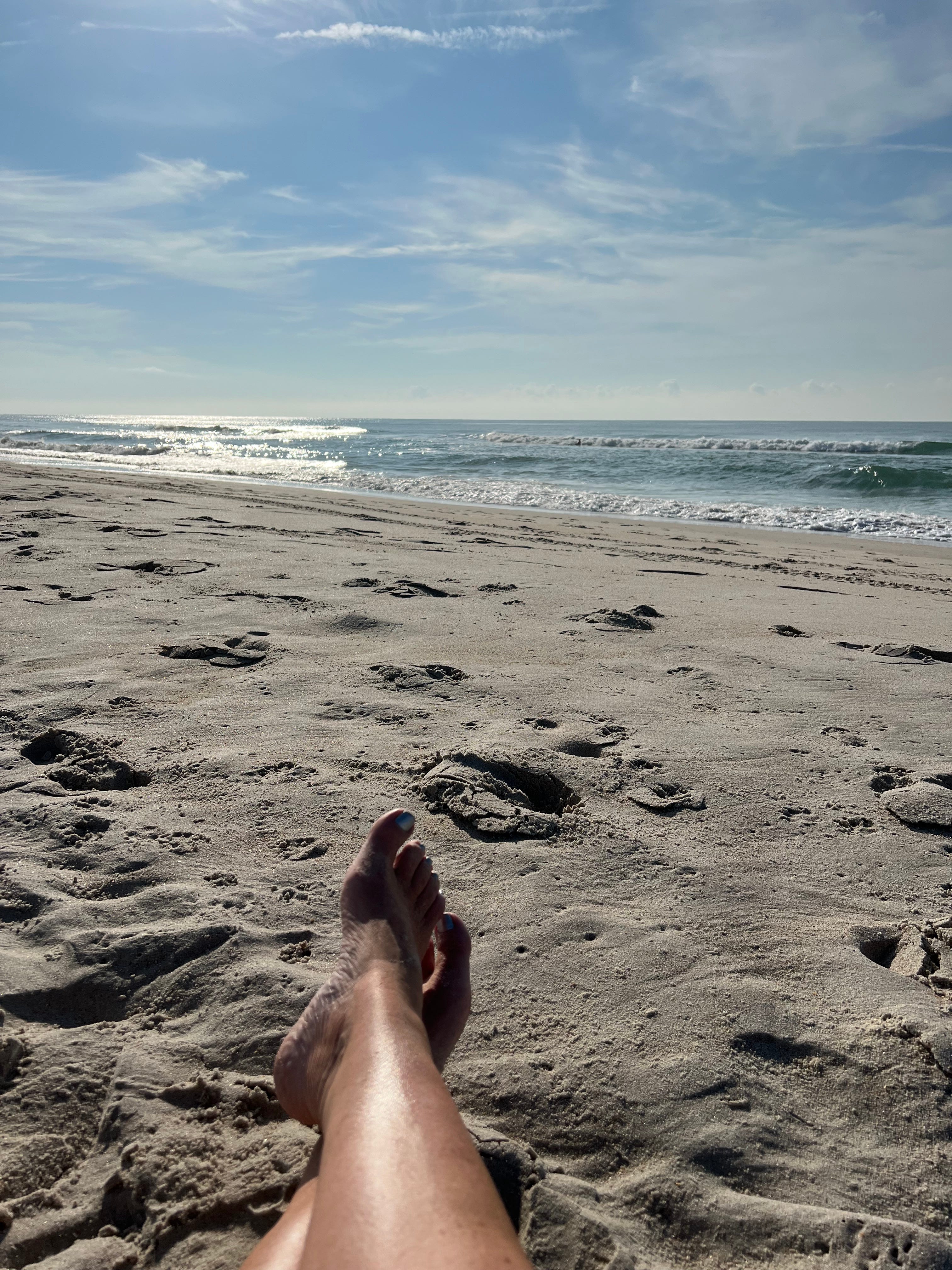 I took this picture one week ago today—enjoying both time and quiet. (The beach definitely helps!)